SYLLABUS
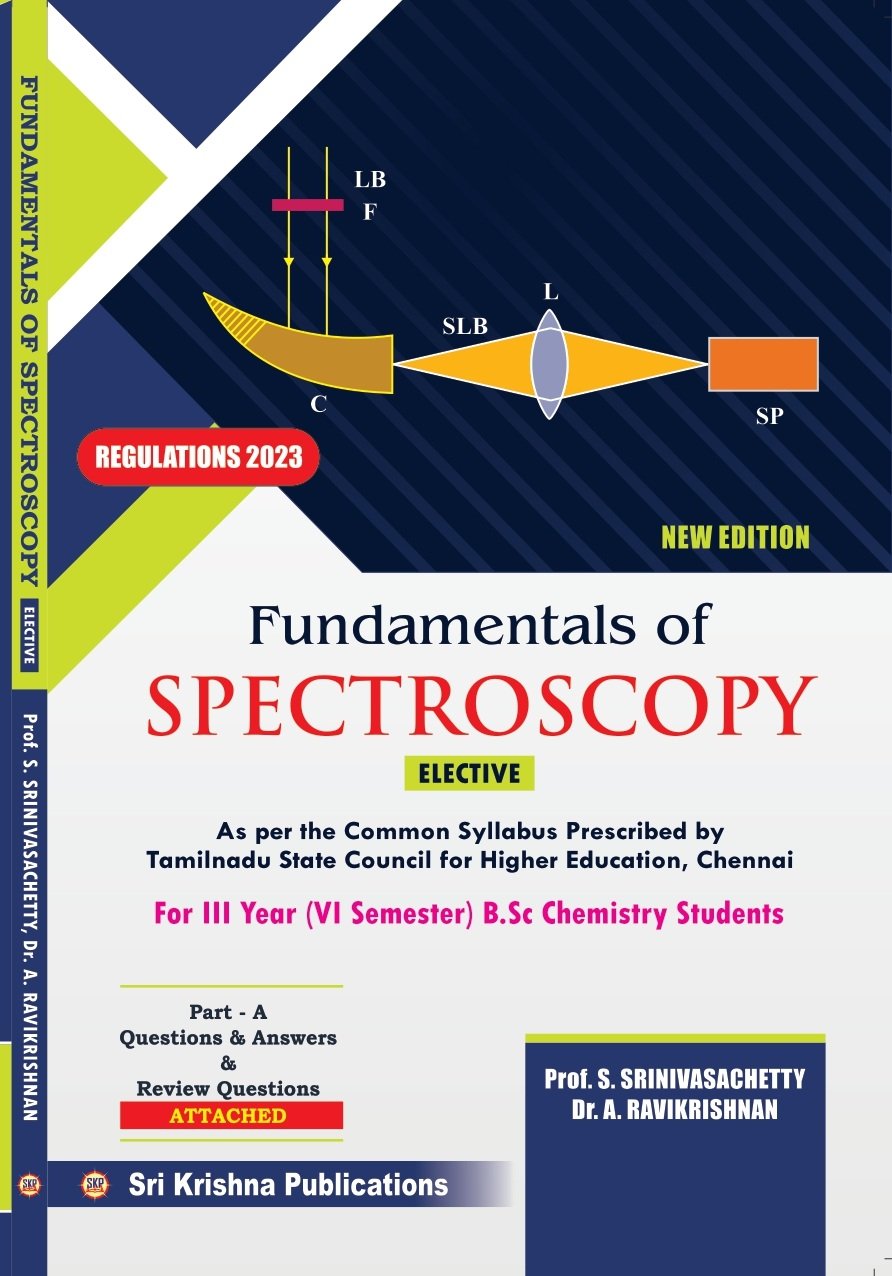
FUNDAMENTALS OF SPECTROSCOPY
Unit : 1 Electrical and Magnetic properties of molecules
Dipole moment polar and nonpolar molecules
polarisability of molecules. Application of dipole moments
in the study of organic and inorganic molecules.
Magnetic permeability, volume susceptibility, mass
susceptibility and molar susceptibility; diamagnetism,
paramagnetism determination of magnetic susceptibility
using Guoy balance, ferromagnetism, anti ferromagnetism
Microwave spectroscopy
Rotation spectra diatomic molecules (rigid rotator
approximation) selection rules determination of bond
length, effect of isotopic substitution instrumentation
and applications
Unit : 2 Ultraviolet and Visible spectroscopy
Electronic spectra of diatomic molecules (Born
Oppenheimer approximation) vibrational coarse
structure rotational fine structure of electronic vibration
transitions Frank Condon principle dissociation in
electronic transitions BirgeSponer method of evaluation
of dissociation energy pre-dissociation transition – σ-σ *,
π-π*, n-σ*, n-π* transitions.
Applications of UV-Woodward Fieser rules as applied
to conjugated dienes and α, β unsaturated ketones.
Elementary Problems.
Colorimetry principle and applications (estimation of Fe3+)
Unit: 3 Infrared spectroscopy
Vibration spectra diatomic molecules harmonic oscillator
and anharmonic oscillator; Vibration rotation spectra
diatomic molecule as rigid rotator and anharmonic
oscillator (Born-Oppenheimer approximation oscillator)
selection rules, vibrations of polyatomic molecules
stretching and bending vibrations applications
determination of force constant, moment of inertia and
internuclear distance isotopic shift application of IR
spectra to simple organic and inorganic molecules (group
frequencies)
Raman Spectroscopy
Rayleigh scattering and Raman scattering of light classical
theory of Raman effect Vibrational Raman spectrum
Raman shift quantum theory of Raman effect selection
rules mutual exclusion principle instrumentation (block
diagram) applications.
Unit : 4 Nuclear magnetic resonance spectroscopy
PMR – theory of PMR – instrumentation – number of
signals – chemical shift peak areas and proton counting
spin-spin coupling applications. Problems related to
shielding and deshielding of protons, chemical shifts of
protons in hydrocarbons, and in simple monofunctional
organic compounds; spin-spin splitting of neighbouring
protons in vinyl and allyl systems.
Unit 5 Mass spectrometry
Principle different kinds of ionisation- instrumentation –
the mass determination of molecular formula-spectrum
types of ions fragmentation and structural elucidation
McLafferty rearrangement; Retro Diels Alder reaction
illustrations with simple organic molecules.
Solving structure elucidation problems using multiple
spectroscopic data (NMR, MS, IR and UV-Vis).






Reviews
There are no reviews yet.