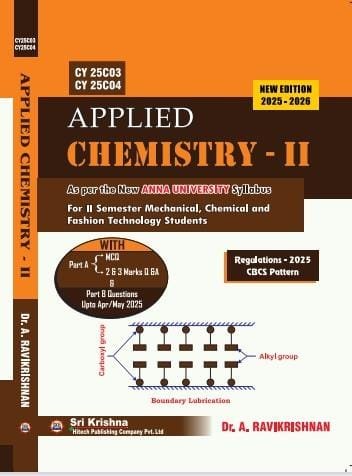
CY25C03 Applied Chemistry (ME) – II
Functional Materials: Types, Smart coatings, Mechanisms,
Sustainable energy materials.
Activities: Seminar on recent development in functional materials
(e.g., smart coatings, self-cleaning surfaces), Infographic Design
of functional nanomaterials
.
Fuels: Classification, Chemical Composition, natural resources,
Calorific Value – Alternative Fuels – Natural gas benefits.
Activities: Comparison of efficiency and emissions in fuels.
Composites: Matrix materials – Reinforcements, Hybrid
composites, Engineering applications.Activities: Design of a simple composite structure for a real
engineering application (e.g., lightweight bike frame).
Lubricants: Types, Functions. Key properties, Synthetic
lubricants, Mechanisms, Emerging lubricants.
Activities: Collection of lubricants used in real-world engineering
systems (e.g., gears, engines, bearings), Virtual demonstration of
lubricant viscosity testing.
Combustion: Reaction Kinetics, Stoichiometric combustion and
air-fuel ratio calculations, Knocking and Anti-knocking agents,
Hydrogen combustion, Flue Gas analysis.
Activities: Virtual simulation of flue gas analysis and gas
composition, Calculation of air-fuel ratio.
Adhesives: Adhesion Mechanisms, Classification, Bond strength,
Industrial adhesives.
Activities: Adhesion of thermal pads on different Integrated
circuits, Industrial adhesives.
Weightage: Continuous Assessment: 40%, End Semester
Examinations: 60%
Assessment Methodology: Quiz (5%), Seminar (5%),
Assignments (30%), Flipped Class (10%), Internal Examinations
(50%)
CY25C04 Applied Chemistry (TECH) – II
Interface and Colloids: Interface region, Interface control,
Emulsion and Foams, Surfactant action.
Activities: Demonstration of oil-water interfaces, Formation of
micelles.
Oils, Fats and Soaps: Types of oils, Properties of oils, Fats –
classification, Soaps and detergents.
Activities: Seminar on the saponification of edible, non-edible
and essential oils.
Lubricants: Mechanism of lubrication, Preparation of Petro
lubes, Characteristics, Semisolid lubricant, Solid lubricants.
Activities: Virtual demonstration of lubrication, Assignment on
the lubricants used in automotive engines.
Adhesives: Adhesive action, Classification of adhesives, Factors
influencing adhesive action, Synthetic adhesives.
Activities: Adherence of liquids on surfaces (Flipped Class
sessions).
Adhesives: Theory of colour and constitution, Classification of
dyes based on application, Chemistry and synthesis of dyes.
Activities: Study of bonding of dyes with fabric (Flipped Class
sessions).
Adhesives:Functions, Classification, Preparation,
Estimation using Iodometry, Permanganometry.
Activities: Estimation of available chlorine, Determination of
strength of hydrogen peroxide, potential hazards of auxiliaries.
Weightage: Continuous Assessment: 40%, End Semester
Examinations: 60%
Assessment Methodology: Quiz (5%), Assignments (20%),
Flipped Class (15%), Virtual Practice (10%), Internal
Examinations (50%)









Reviews
There are no reviews yet.