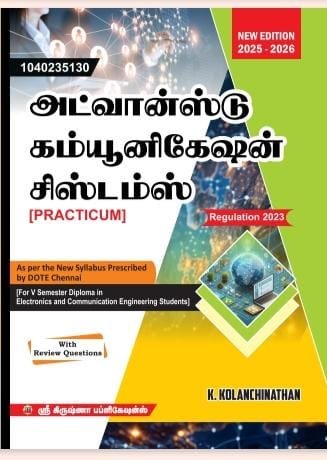
Unit I DIGITAL MODULATION TECHNIQUES
Digital modulation techniques – ASK, FSK, PSK, QPSK modulation and demodulation
techniques (only block diagram, operation and waveforms) – Basic concept of OFDM
6
Ex.No Name of the Experiment
1. Test the performance of ASK modulator and demodulator & draw its input
and output waveform.
3
Unit II SATELLITE COMMUNICATION
Kepler’s I, II, III laws – orbits – launching orbits – types – Geostationary synchronous
satellites – Advantages – Apogee – Perigee – Active and passive satellite -Satellite mobile
services – Basics of DTH- Basic concept of GPS and NavIC-Multiple Access Techniques
-TDMA, FDMA and CDMA
6
Ex.No Name of the Experiment
2. Install a DTH system and test its performance. 3
Unit III OPTICAL COMMUNICATION
Optical Sources – LED – Semiconductor LASER – Principles – Optical Detectors – PIN
and APD Diodes – connectors -splices – couplers- Optical transmitter – Block diagram
– Optical receiver – Block diagram – Application of optical fibers.
6
Ex.No Name of the Experiment ……
3. Test the performance of a fiber optic analog link and draw its input and
output waveforms.
3
Unit IV MICROWAVE COMMUNICATION
Types of propagation – Ground wave, Sky wave and Space wave propagation –
Microwave frequency ranges – Simple block diagram and operation of microwave
transmitter, receiver and microwave link repeater – Basic concepts of horn antenna.
6
Ex.No Name of the Experiment
4. Study the directional characteristics of horn antenna. 3
Unit V DIGITAL CELLULAR SYSTEM
Global system for mobile communications (GSM)-GSM services-GSM System
Architecture – Basics of GPRS.
6
Ex.No Name of the Experiment
5. Study the working of SIM card in GSM handset and SIM card detection.










Reviews
There are no reviews yet.