SYLLABUS
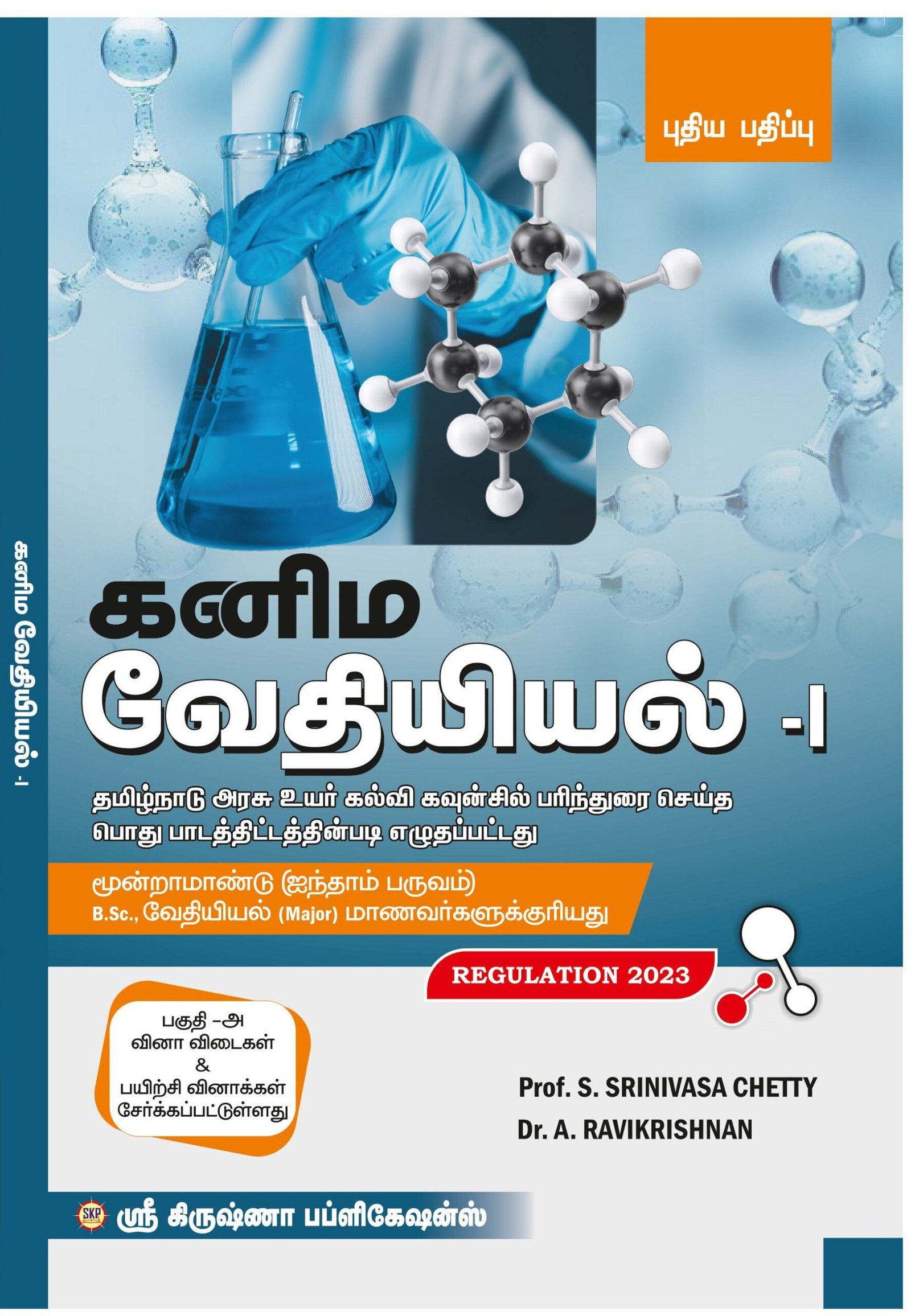
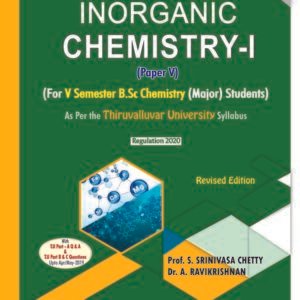
INORGANIC CHEMISTRY – I
UNIT – I: CO-ORDINATION CHEMISTRY – I
IUPAC Nomenclature of coordination compounds,
Isomerism in coordination compounds. Werner’s coordination
theory – effective atomic number – interpretation of geometry
and magnetic properties by Pauling’s theory – geometry of
coordination compounds with coordination number 4 & 6.
Chelates – types of ligands forming chelates – stability
of chelates, applications of chelates in qualitative and
quantitative analysis – application of DMG and oxine in
gravimetric analysis – estimation of hardness of water using
EDTA, metal ion indicators.
Role of metal chelates in living systems – haemoglobin
and chlorophyll
UNIT – II: CO-ORDINATION CHEMISTRY – II
Crystal field theory – Crystal field splitting of energy
levels in octahedral and tetrahedral complexes, Crystal field
stabilization energy (CFSE), spectrochemical series –
calculation of CFSE in octahedral and tetratehdral complexes
– factors influencing the magnitude of crystal field splitting,
crystal field effect on ionic radii, lattice energies, heats of
ligation with water as a ligand (heat of hydration),
interpretation of magnetic properties, spectra of [Ti(H2O)6]3+
– Jahn – Teller effect. Stability of complexes in aqueous
solution, stability constants – factors affecting the stability of
a complex ion, thermodynamic and kinetic stability (elementary
idea). Comparison of VBT and CFT.
UNIT – III: ORGANOMETALLIC COMPOUNDS
Metal Carbonyls
Mono and polynuclear carbonyls, General methods of
preparation of carbonyls – general properties of binary
carbonyls – bonding in carbonyls – structure and bonding in
carbonyls – structure and bonding in carbonyls of Ni, Fe, Cr,
Co, Mn, Ru and Os. EAN rule as applied to metal carbonyls.
Ferrocene-Methods of preparation, physical and chemical
properties
UNIT – IV: INNER TRANSITION ELEMENTS
(LANTHANOIDS AND ACTINOIDS)
General characteristics of f-block elements –
Comparative account of lanthanoids and actinoids –
Occurrence, Oxidation states, Magnetic properties, Colour and
spectra – Lanthanoids and Actinoids, Separation by
ion-Exchange and Solvent extraction methods – Lanthanoids
contraction – Chemistry of thorium and Uranium-Occurrence,
Ores, Extraction, properties and uses – Preparation, Properties
and uses of ceric ammonium sulphate, thorium dioxide and
uranyl acetate.
UNIT – V: INORGANIC POLYMERS
General properties – classification of inorganic polymers
based on element in the backbone (Si, S, B and P) –
preparation and properties of silicones (polydimethylsiloxane
and polymethylhydrosiloxane) phosphorous based polymer
(polyphosphazines and polyphophonitrilic chloride), sulphur
based polymer (polysulfide and polymeric sulphur nitride),
boron based polymers (borazine polymers) – industrial
applications of inorganic polymers.





Reviews
There are no reviews yet.