
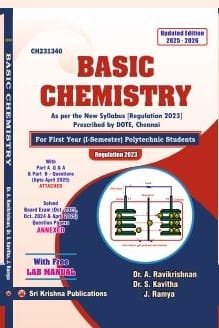
CH231340 Basic Chemistry
Unit I SOLUTION CHEMISTRY
Solution –Solute, Solvent – dilute and concentrated solution – methods of
expressing the concentration of the solution – molality – molarity –
normality(simple numerical problems only). Properties of acids and bases -Lewis
concept of acids and bases –advantages – pH and pOH – Definition – Indicator –
Definition – Buffer solution – Definition – Types of buffer solution with examples –
Application of pH in industries.
6
Ex 1. Estimation of sulphuric acid
Ex 2. Estimation of strong acid by pH metry
6
Unit II SURFACE CHEMISTRY
Colloids – Definition – True solution and Colloidal solution – Differences –
lyophilic colloids and lyophobic colloids (definitions only) – Properties – Tyndall
effect – Brownian movement – Industrial applications of colloids. Smoke
Precipitation by Cottrell’s method, Purification of water, Catalyst – Definition –
Positive – Negative catalyst – Definition – Types of catalysis – Homogeneous and
Heterogeneous catalysis examples– Characteristics of a catalyst – Industrial
applications of catalysts.
6
Ex 3. Preparation of lyophilic colloids and lyophobic colloids 6
Unit III POLYMER CHEMSITRY
Plastics – types – Types of Polymerization-Addition and condensation
polymerization Thermoplastics and Thermoset plastics – Differences – Mechanical
properties of plastics – Advantages of plastics over traditional materials-Natural
polymer – Rubber – Extraction of rubber from latex – defects of natural rubber –
Vulcanization – Compounding of rubber –Ingredients and their functions.
6
Ex 4. Preparation of thermosetting resin-Urea-formaldehyde resins 6
Unit IV ELECTRO CHEMISTRY
Electronic concept of oxidation and reduction– electrolytes -classification-strong,
weak and non-electrolyte – examples – electrolysis – definition – Mechanism –
Industrial applications of Electrolysis – Chrome plating – Primary Battery –
Secondary Battery – Definition, examples & construction of Li-ion Battery.
Corrosion (Definition)– Differential aeration theory only – Factors Influencing
Rate of Corrosion. – Methods of Prevention of Corrosion (qualitative).
6
Ex. 5. Estimation of Mohr’s salt by permanganometry
Ex. 6. Comparison of strength of two KMnO
4
solutions
6
Unit V ENVIRONMENTAL CHEMISTRY
Air pollution – Definition – Air pollutants (SO2, H2S, HF, CO and Dust) – Sources
and Harmful effects – Formation of Acid Rain – Harmful effects – Green House
Effect – Causes – Ozone layer depletion and its harmful effects- Global warming –
Harmful effects – Control of Air Pollution. Solid Waste – Definition – Problems –
Types of Solid waste methods of Disposal – Land fill and Incineration –
Recycling – Definition – Examples – Advantages of Recycling (Basic ideas) Green
Chemistry Definition – Goals of Green Chemistry.
6
Ex 7. Crystallization of copper sulphate and identification of ions
Ex 8. Decolorization of clayey water using sand bed.









Reviews
There are no reviews yet.