
DETAILED SYLLABUS
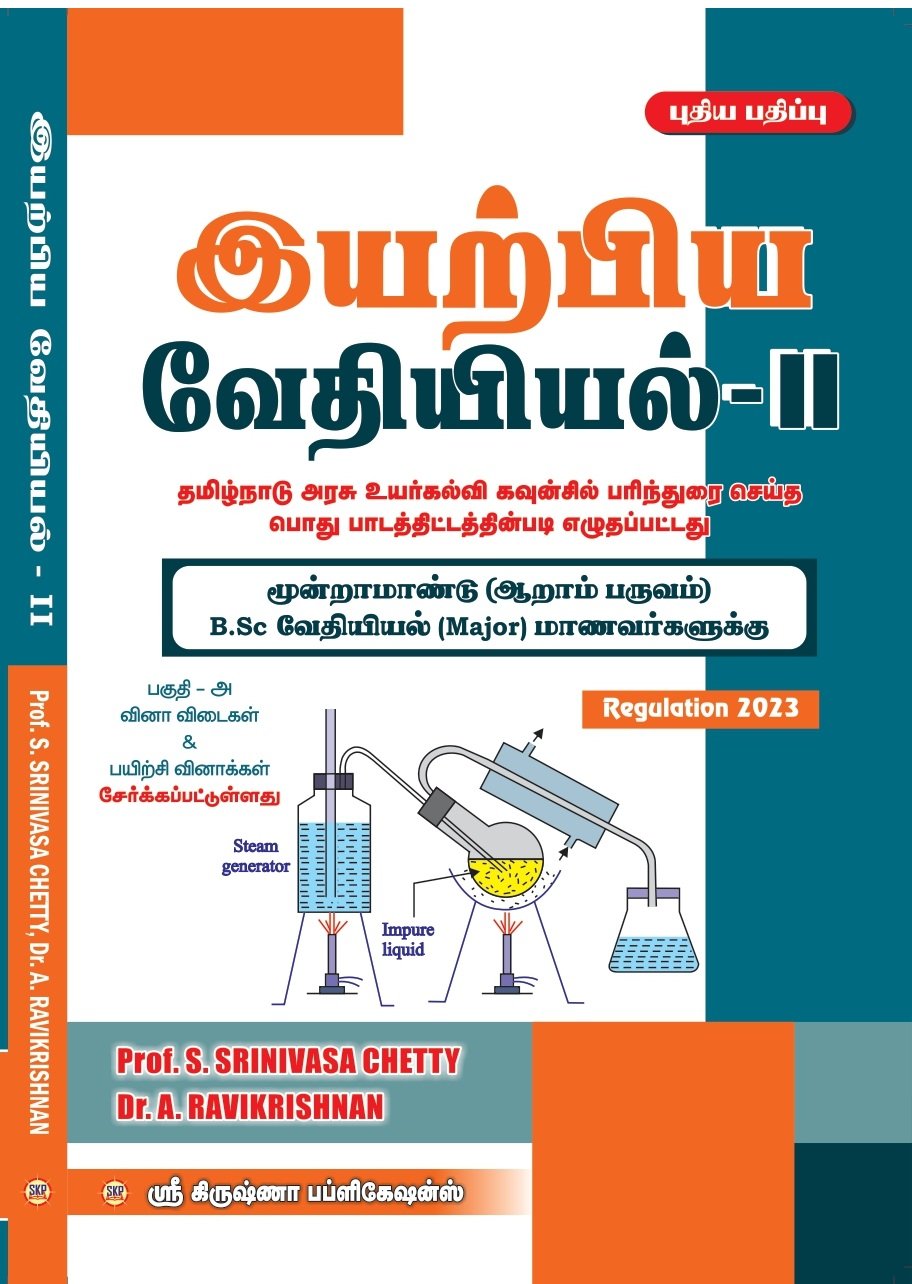
PHYSICAL CHEMISTRY – II
Unit I Phase rule
Definition of terms, derivation of phase rule application to one
component systems water and sulphur – super cooling, sublimation; two
component systems solid liquid equilibria- simple eutectic (lead – silver
and bismuth cadmium), freezing mixtures (potassium iodide- water),
compound formation with congruent melting points (magnesium zine
and ferric chloride water system), peritectic change (sodium potassium),
solid solution (gold-silver); copper sulphate water system.
UNIT II Chemical equilibrium
Law of mass action thermodynamic derivation relationship between. Kp
and Kc application to the homogeneous equilibria – dissociation of PCl5
gas, N2O4 gas equilibrium constant and degree of dissociation formation
of HI, NH3 and SO3-heterogeneous equilibrium decomposition of solid
calcium carbonate Lechatelier principle van’t Hoff reaction isotherm
temperature dependence of equilibrium constant – van’t Hoff reaction
isochore – Clayperon equation -Clausius Clayperon equation and its
applications.
UNIT III Binary liquid mixtures
Ideal liquid mixtures fractional distillation non ideal solutions
azeotropic mixtures partially miscible mixtures phenol-water,
triethylamine-water, nicotine-water effect of impurities on critical
solution temperature; immiscible liquids steam distillation; Nernst
distribution law applications.
UNIT IV Electrical Conductance and Transference
Arrhenius theory of electrolytic dissociation – Ostwald’s dilution
law, limitations of Arrhenius theory; behavior of strong electrolytes
interionic effects Debye Huckel theory-Onsager equation (noderivation),
significance of Onsager equation, Debye Falkenhageneffect, Wien
effect. Ionic mobility Discharge of ions on electrolysis (Hittorf’s
theoretical device), transport number determination Hittorf’s
method, moving boundary method factors affecting transport number
– determination of ionic mobility, Kohlrausch’s law-applications;
molar ionic conductance and viscosity (Walden’s rule); applications
of conductance measurements determination of degreeof dissociation
of weak electrolyte, dissociation constant of weak acidand weak base,
ionic product of water, solubility and solubility productof sparingly
soluble salts -conductometric titrations-acid base titrations.
UNIT V Galvanic Cells and Applications
Galvanic cell, representation, reversible and irreversible cells, EMF
and its measurement standard cell; relationship between electrical
energy and chemical energy; sign of EMF and spontaneity of a reaction,
thermodynamics and EMF calculation of ΔG, ΔH, and ΔS from EMF
data; reversible electrodes, electrode potential, standard electrode
potential, primary and secondary reference electrodes, Nernst equation
for electrode potential and cell EMF; types of electrodes metal/metal
ion, metal amalgam/metal ion, metal, insoluble salt/anion, gas electrode,
redox electrode: electrochemical series applications of electrochemical
series. Chemical cells with and without transport, concentration cells
with and without transport.
Unit Name of the Topic
Applications of EMF measurements
Applications of EMF measurements determination of activity coefficient
of electrolytes, transport number, valency of ions, solubility product,
pH using hydrogen gas electrode, quinhydrone electrode and glass
electrode, potentiometric titrations acid base titrations, redox titrations,
precipitation titrations, ionic product of water and degree of hydrolysis;
redox indicators – use of diphenylamine indicator in the titration of
ferrous iron against dichromate.
Industrial component
Galvanic cells- lead storage, Ni-Cd, Li and Zn-air, Al-air batteries
Fuel cells-H2O2 cell-efficiency of fuel cells.
Corrosion-mechanism, types and methods of prevention




















Reviews
There are no reviews yet.