SYLLABUS
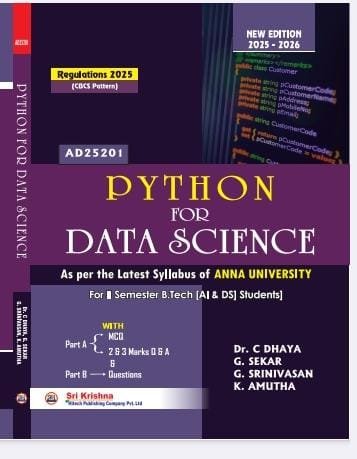
PYTHON FOR DATA SCIENCE
Chapter 1: Basics of Python
This chapter introduces the Python programming language—its origins, purpose, and
features. Learners gain familiarity with the Python interpreter and understand essential
language semantics. Core programming elements such as data types, variables, operators,
and flow-control statements are covered in depth. Fundamental data structures including
lists, tuples, sets, and dictionaries are explored to develop strong programming
foundations.
Practical exercises reinforce concepts using conditional statements, loops, and operations
on various Python collections.
Chapter 2: Functions, Classes, and File Handling
Building on the fundamentals, this chapter delves deeper into defining and using
functions, handling arguments, returning values, and working with lists inside functions. It
also introduces object-oriented programming through class creation. A detailed discussion
on string manipulation and file I/O operations trains learners to read from and write to
external files. Exception handling and library imports are included to equip learners for
robust programming.
Practical components include programs involving functions, classes, string handling,
and file processing.
Chapter 3: Foundations of Data Science
This chapter provides an overview of Data Science and its vast applications. Students
are introduced to the data science process—from defining research goals and retrieving
data to preparing, cleaning, and transforming datasets. Key concepts such as handling
missing values, detecting outliers, conducting exploratory data analysis, and building
preliminary models are introduced. The chapter also examines data mining and data
warehousing as critical components of modern analytics.
Hands-on practice covers data creation, mathematical operations, and graphical data
representation.
Chapter 4: Descriptive Analytics
Focusing on statistical data description, this chapter explores different types of
variables and techniques to summarize data using tables, graphs, averages, and measures
of variability. Learners study normal distributions, z-scores, correlation analysis,
scatterplots, and computation of the correlation coefficient. The fundamentals of
regression analysis, including the least-squares regression line, are presented in a clear and
accessible manner.
Practical work includes descriptive statistics without libraries, computing correlation
coefficients, and implementing a linear regression model.
Chapter 5: NumPy and Pandas for Data Analysis
This chapter introduces two essential data science libraries: NumPy and Pandas.
Students learn about array creation, attributes, and operations such as joining, splitting,
searching, sorting, indexing, slicing, and reshaping arrays. Pandas content includes Series
and DataFrames, reindexing operations, data alignment, ranking, sorting, summary
statistics, and hierarchical indexing.
Practical exercises guide learners through creating NumPy arrays, performing
slicing/indexing, and manipulating multiple DataFrames.
Chapter 6: Data Visualization
The final chapter emphasizes the importance of visual communication using
Matplotlib and Seaborn. Learners explore various types of plots—line, bar, histogram,
box, scatter, pair plots, and 3D surface visualizations. Additional topics include subplot
creation, controlling axes, customizing ticks and labels, annotating graphs, applying styles,
and saving plots.
Hands-on tasks include generating basic plots, customizing them, and creating advanced
Seaborn visualizations.






Reviews
There are no reviews yet.