
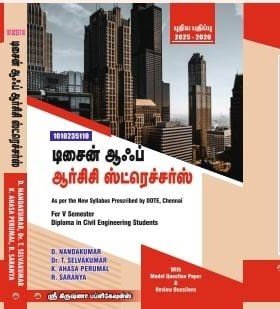
1010235110 – DESIGN OF RCC STRUCTURES
(Limit State Method)
UNIT I: INTRODUCTION TO LIMIT STATE
METHOD OF DESIGN IN CONCRETE 12
1.1 INTRODUCTION TO LIMIT STATE METHOD OF
DESIGN IN CONCRETE
Reinforced Cement Concrete Materials used in R.C.C
and their basic requirement – Purpose of providing
reinforcement- Different types and grades of cement and steel
– Characteristic strength and grades of concrete as per IS
456-2000.
Limit State Method – Concept – Advantages – Different
limit states Characteristic strength and design strength of
materials – Characteristic loads and design loads – Partial
safety factors for loads and material strength – Limit state of
collapse in flexure – Assumptions – Limiting values of neutral
axis of singly reinforced section for different grades of steel
– Moment of resistance of singly and doubly reinforced
rectangular sections – Problems.
1.2 DESIGN OF RECTANGULAR BEAMS FOR FLEXURE
Design requirements – Effective spans of cantilever and
simply supported beams – Breadth and depth requirements of
beams – Control of deflection – Minimum depth requirement
for stiffness – Minimum concrete cover to reinforcement steel
for durability and fire resistance – Minimum and maximum
areas/ spacing for main reinforcement and side face
reinforcement as per IS 456-2000 – Development Length –
Anchorage values of bends and hooks – Curtailment of
reinforcements – Design bending moments – Design of singly
and doubly reinforced rectangular beams (Cantilevers and
simply supported beams carrying udl only) – Problems.
(iv)
UNIT II: DESIGN OF RECTANGULAR BEAMS FOR
FLEXURE AND SHEAR 12
2.1 DESIGN OF BEAMS FOR SHEAR
Limit state of collapse in shear – Design shear strength
of concrete – Design shear strengths of vertical / inclined
stirrups and bent up bars – Principle of shear design – Critical
sections for shear – S.F Coefficients specified by IS:456 – 2000
– Nominal shear stress – Minimum shear reinforcement –
Design of rectangular beams using vertical stirrups by limit
state method.
2.2 PLANNING OF STAIRCASE
Types of stairs – Effective span of stairs as per IS code
– Classification based on structural behaviour – standard
dimensions – Planning of dog legged staircase.
UNIT III: DESIGN OF T-BEAMS AND
CONTINUOUS BEAMS 12
3.1 DESIGN OF T-BEAMS FOR FLEXURE
Cross sections of Tee and L-beams- Effective width of
flange-Neutral Axis and M.R of Single Reinforced T-Sections-
Design of singly reinforced T-beams for flexure-Problems on
Simply supported T-beams carrying udl only.
3.2 DESIGN OF CONTINUOUS BEAMS FOR FLEXURE
Methods of analysis of continuous beams – Effective
Span – Arrangement of Loading for Critical Bending Moments
– B.M coefficients specified by IS: 456-2000 Design of
rectangular continuous beams (Single Reinforced) using B.M.
coefficients (equal spans & u.d.l only) for sagging and hogging
moments.
(v)
UNIT IV: DESIGN OF SLABS 12
4.1 DESIGN OF ONE WAY SLABS
Classification of Slabs Effective spans – Loads(DL and
IL) on floor/roof slabs and stairs (IS:875-1987) – Strength and
Stiffness requirements – Minimum and maximum permitted
size, spacing and area of main and secondary reinforcements
as per IS 456-2000 – Cover requirement to reinforcements in
slabs – Design of cantilever/simply supported one way slabs
by limit state method – Check for shear and stiffness.
4.2 DESIGN OF TWO WAY SLABS
Introduction – Effective spans – Thickness of slab for
strength and stiffness requirements – Middle and Edge strips
– B.M coefficients as per IS: 456 for Simply supported and
Continuous slabs – Design of simply supported two way slabs.
UNIT V: DESIGN OF R.C.C. COLUMNS AND
COLUMN FOOTINGS 12
5.1 DESIGN OF R.C.C COLUMNS
Limit state of collapse in compression – Assumptions –
Limiting strength of short axially loaded compression members
– Effective length of compression members – Slenderness limits
for columns – Classification of columns – Minimum eccentricity
for column loads – Longitudinal and Transverse reinforcement
requirements as per IS 456-2000 – Clover requirement – Design
of axially loaded short columns with lateral ties.
5.2 DESIGN OF COLUMN FOOTING
Basic requirements of Footings – Types of R.C footings
– Minimum depth below GL – Footings with uniform thickness
and varying thickness (sloped footing) – Critical sections for
BM, Transverse/Punching Shears – Minimum reinforcement –
Development length, Anchorage, Cover, Minimum edge
thickness requirements as per IS 456-2000 – Design of Isolated
square and rectangular footings.
(vi)














Reviews
There are no reviews yet.