

SYLLABUS
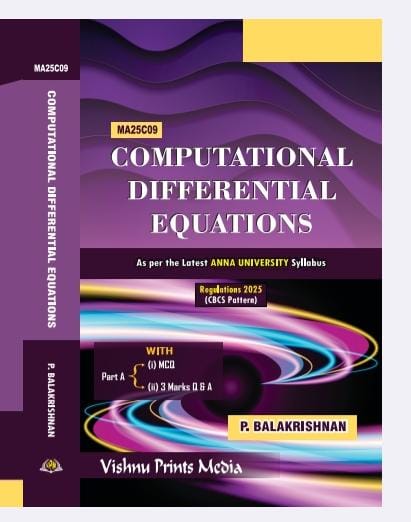
MA25C09
COMPUTATIONAL DIFFERENTIAL
EQUATIONS
Unit – I: First Order Ordinary Differential Equations
Basic concepts of ordinary differential equations – Formation of first
order differential equations from physical problems–First order and
first-degree ODE: Variables separable–Exact equations–Leibnitz’s equation
– Bernoulli’s equation – Numerical Methods: Solving first order ODE by
Euler’s formula, Taylor series and Runge Kutta method of 4th order.
Activities: Application and Visualization of the first order ODE using
open-source software and solving Competitive Examination questions
Unit – II: Higher Order Ordinary Differential Equations
Formation of second order differential equations from physical
problems–Linear equations of second and higher order with constant
coefficients – Euler’s linear equations – Method of variation of
parameters–Numerical Methods: Solving second order ODE by
Runge-Kutta method of 4th order and finite difference method.
Activities: Solving ordinary differential equations using open-source
software and solving of Competitive Examination questions
Unit – III: First Order Partial Differential Equations
Formation of partial differential equations by elimination of arbitrary
constants and arbitrary functions – Solution of PDE by variable separable
method – Solution of standard types of first order partial differential
equations (excluding reducible to standard types) – Lagrange’s linear
equation – Numerical Methods for first order PDE by Method of lines
with Runge-Kutta method of order fourth.
Activities: Application and Visualization of the Partial Differential
Equations using open-source software and solving Competitive
Examination questions
(iii)
Unit – IV: Higher Order Partial Differential Equations
Linear homogeneous partial differential equations of second and
higher order with constant coefficients. Numerical Methods: Finite
difference techniques for the solution of two-dimensional Laplace’s and
Poisson’s equations on rectangular domain-Solution of one-dimensional
heat equation using Bender Schmidt and Crank Nicholson difference
schemes–Solution of one-dimensional wave equation by explicit scheme.
Activities: Application of the second order PDE using open-source
software of 1-D wave, 1-D heat equations, Laplace and Poisson equations
and Solving Competitive Examination questions












Reviews
There are no reviews yet.